The 7 persuasion levers in cold email (with examples)
The seven classic principles of influence aren't trivia — each one maps to a concrete move in a cold email. Here's how reciprocity, commitment, social proof, authority, liking, scarcity, and unity actually show up in a sequence, with examples.

Persuasion isn’t a tip. It’s a spec. The seven principles of influence — popularized by Robert Cialdini and validated across decades of research — get quoted everywhere and applied almost nowhere, because most people treat them as cocktail-party trivia instead of build instructions.
They’re not a ranked law and they’re not magic. They’re levers. Each one maps to a specific, concrete move you can make in a cold email — and if you can’t encode a principle into an actual line of copy or a sequence step, it’s just trivia. Here’s how each one shows up in practice.
A note before we start: these levers move your reply rate. They have nothing to do with whether you land in the inbox — that’s deliverability, a separate engineering problem. Don’t confuse the two. Everything below assumes your email is actually being delivered.
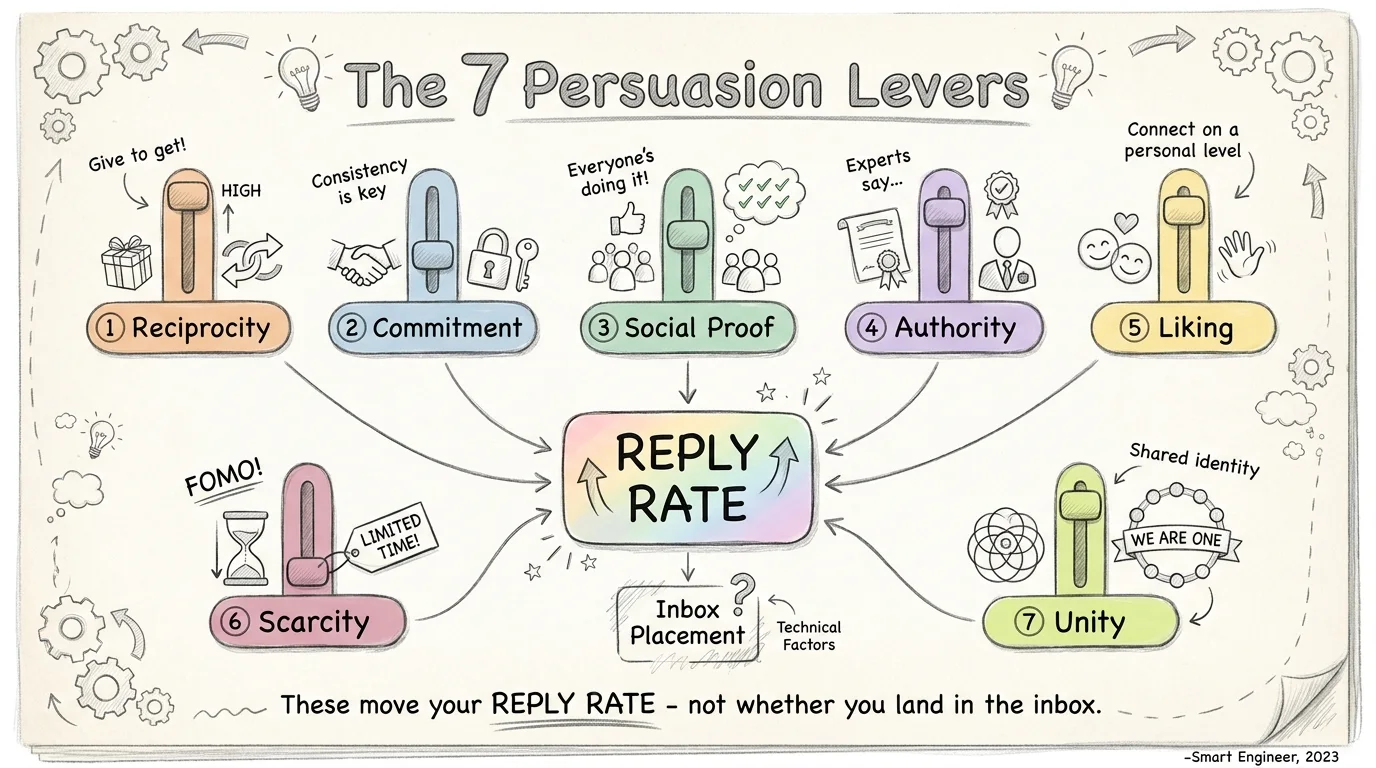
1. Reciprocity — give before you ask
The principle: people feel compelled to return favors. The cold-email move: lead with something genuinely useful before any ask, and make it specific enough that it obviously took effort.
- Weak: “I’d love to show you our platform.”
- Better: “I noticed your careers page is hiring 3 SDRs — I put together a one-pager on the outbound mistakes that usually cost teams their first quarter ramp. Want it? No pitch attached.”
The give has to be real. A “free audit” that’s actually a sales call is fake reciprocity, and people know.
2. Commitment & consistency — ask for the small yes first
The principle: once someone takes a small step, they’re more likely to take a bigger consistent one. The move: ladder your asks. Don’t open by asking for 30 minutes. Ask for a one-word reply, or a yes/no, or permission to send the thing.
- Weak: “Can we book a 30-minute call this week?”
- Better: “Worth me sending the 2-minute breakdown? Just reply ‘yes.’”
The first email’s only job is to earn the second. Sequences win because most replies come after the first touch — you’re laddering commitments, not swinging for the close on email one.
3. Social proof — show the most similar others
The principle: people look to others like them to decide what’s reasonable. The move: surface the most similar customer or result, not a logo wall. One relevant peer beats ten irrelevant brands.
- Weak: “Trusted by 500+ companies.”
- Better: “We did this for another B2B team with a 4-person sales org in your space — happy to share what changed.”
Specific and similar. A logo wall of enterprises is social proof for an enterprise; it’s noise to a 10-person agency. (And only say it if it’s true — a fabricated peer is worse than none.)
4. Authority — earned and shown, never claimed
The principle: people defer to credible expertise. The move: demonstrate it by what you’ve shipped or know, shown plainly — don’t assert it with adjectives.
- Weak: “We’re the leading experts in AI outbound.”
- Better: “Here’s the exact 6-stage system we run, including the deliverability setup most people skip. Build it yourself or have us run it.”
Authority you have to claim isn’t authority. Show the work and let the reader conclude it.
5. Liking — real rapport from real homework
The principle: people say yes to people they like, and liking comes from genuine, specific attention. The move: personalize from something true and recent — not Hi {{first_name}}, but a real observation that proves you looked.
- Weak: “I love what you’re doing at [Company]!”
- Better: “Your talk on industrial AR adoption — the bit about procurement cycles being the real bottleneck — that’s exactly the gap our system is built around.”
One caveat we’re strict about: liking lifts replies. It does nothing for deliverability. Real personalization is a psychology lever, not an inbox-placement trick.
6. Scarcity — true and time-bound, or not at all
The principle: people value what’s limited. The move: use real scarcity — a genuine cap, a real deadline, an honest constraint — and never a fake one.
- Fake (don’t): “Only 2 spots left!!” (there aren’t)
- Real: “We cap done-for-you at 5 clients because it’s hands-on. Spots are filling, and pricing rises as the waitlist builds — that’s the honest reason to decide now, not a countdown timer.”
Manufactured urgency is the fastest way to torch trust. Real scarcity, stated plainly, is one of the strongest honest closers there is.
7. Unity — same side, same fight
The principle: people are moved by shared identity — not just similarity, but a sense of us. The move: frame the work as a shared goal within a shared world.
- Weak: “We help businesses grow.”
- Better: “We both know B2B buyers don’t decide the way the funnel diagrams pretend. Building outreach around how they actually decide is the whole game — that’s the side we’re on.”
Unity is the difference between selling to someone and standing with them against a common problem.
We apply these seven levers to every cold email we write and A/B test.
The point isn’t to use all seven
You won’t stack all seven into one email — that would read as exactly the manipulation these principles get accused of. Pick the two or three that are true for your situation and execute them cleanly. A single honest lever, applied well, beats seven crammed in.
And that’s the real spec: persuasion that works is persuasion that’s true. The levers are just names for the ways relevance and honesty show up in writing. Used to manufacture feelings that aren’t real, they backfire fast — people feel handled. Used to surface a genuine reason to care, they’re how a stranger becomes a conversation.
If you want the full system these fit into — the list, the infrastructure, the sequences — that’s all in the cold email system and the definition of AI Sales Psychology that frames it.